For decades, pain cream meant menthol. Maybe camphor. If you were fancy, some lidocaine.
But the landscape is changing. Fast.
The global topical pain cream market is evolving from a undifferentiated OTC pharmaceutical adjunct to a sophisticated consumer self-care category. Consumers are trading up from generic menthol-based creams to formulations featuring CBD, high-dose capsaicin, MSM, glucosamine, and other botanicals with perceived “clean” or “natural” benefits.
As a pain cream OEM manufacturer, Kangzhimei tracks these trends closely. We help brands capitalize on emerging opportunities — from the $1.3B CBD pain cream market** (projected to reach **$5B by 2035) to hydrogel formulations that prolong drug residence time.
In this guide, we explore the next generation of pain cream: the ingredients, technologies, and market dynamics shaping the future of topical pain relief.
Part 1: The Market Is Bifurcating — And That’s an Opportunity
The global topical pain cream market is no longer a single category.
| Arena | Characteristics | Growth Rate | Who Wins |
|---|---|---|---|
| Mass market | High volume, low margin, price-driven, private-label heavy | 2–3% | Retailers with private-label portfolios |
| Premium/benefit-led | Ingredient storytelling, natural claims, perceived efficacy | 6–8% | Brands with compelling narratives and real formulation differentiation |
Private-label penetration is now 10–15% of volume in drugstore channels and expected to reach 18–22% by 2035. This exerts severe margin pressure on mass-market brands — forcing them to either compete on price or retreat into higher-margin segments where retailer brands have weaker credibility.
What this means for new brands: Entering the mass market is a losing game. Entering the premium/benefit-led segment with real formulation innovation is where the opportunity lies.
Long-tail keyword: premium pain cream market trends 2026
Part 2: The CBD Pain Cream Boom — $1.3B and Growing
The CBD pain cream market is one of the fastest-growing segments in topical pain relief. Valued at $1.3 billion in 2024**, it is projected to reach **$5 billion by 2035 at a 13.1% CAGR.
| Factor | Impact |
|---|---|
| Increasing consumer awareness of CBD‘s therapeutic properties | Rising demand for natural, non-pharmaceutical pain relief |
| Favorable regulatory evolution (2018 Farm Bill in US; EU Novel Foods pathway) | Market access expanding |
| Aging population seeking alternative pain management | Reduced reliance on traditional opioids |
| Full-spectrum awareness — consumers seeking “entourage effect” | Demand for wider range of cannabinoids |
| Region | 2024 Value | 2035 Projection | Growth Story |
|---|---|---|---|
| North America | $600M | $2B | Dominant — favorable regulations, high consumer awareness |
| Europe | Growing | Significant | EU Novel Foods regulation facilitates innovative formulations |
| Asia-Pacific | Emerging | Rapid growth | Rising disposable income, evolving regulations (Thailand legalized medical cannabis) |
Key players: Charlotte‘s Web, Medterra, Green Roads, Papa & Barkley, Purekana, Joy Organics.
Kangzhimei’s position: We manufacture CBD pain cream ODM for clients in markets where it‘s legal. We strictly follow local regulations — we do not make medical claims; we provide the formulation and documentation, and your legal team handles final labeling.
Long-tail keyword: cbd pain cream market growth 2026
Part 3: The Capsaicin Revolution — From OTC Creams to 8% Clinic-Applied Patches
Capsaicin is not new. But its application is evolving dramatically.
Traditional OTC capsaicin: 0.025–0.1% in creams and lotions. Works gradually (2–4 weeks). Mild to moderate relief.
The new frontier: Capsaicin 8% patches, applied in clinic settings, providing three to five months of pain relief from a single 60-minute application.
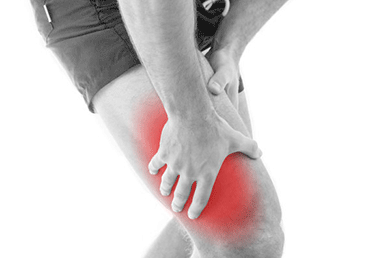
Case study — meralgia paresthetica (thigh nerve compression):
A 72-year-old woman with multiple medical problems (liver disease, obesity, bleeding risk) developed severe thigh pain. She had tried lidocaine 5% patches, capsaicin 0.1% patches, gabapentin, and oxycodone — minimal relief. Invasive procedures were too risky.
She was treated with a capsaicin 8% patch in a supervised clinic setting. Following treatment, she reported 100% relief without side effects. Each application offered three to five months of pain relief.
This is the first reported case of using capsaicin 8% patches for meralgia paresthetica — but it builds on established evidence for postherpetic neuralgia (shingles pain).
Implications for the pain cream market:
- High-dose capsaicin is moving from “cream” to “patch” to “professional treatment”
- This creates a two-tier market: OTC creams for daily management (Kangzhimei‘s specialty) and high-dose patches for severe cases (clinic-administered)
- OTC brands can position their warming pain creams as “the daily maintenance solution” alongside professional high-dose treatments
Long-tail keyword: high dose capsaicin patch for nerve pain relief
Part 4: Hydrogel Formulations — The Delivery Technology of the Future
Hydrogels — highly hydrated, biocompatible polymer networks — are increasingly investigated as drug-delivery systems for analgesics.
Why hydrogels matter for pain cream:
Key findings from a 2025 scoping review of 26 clinical studies on hydrogel analgesics:
- Most common drug class delivered: local anesthetics (46.2% — lidocaine, ropivacaine, bupivacaine)
- Most common applications: topical/transdermal (38.5%) and perioperative/incisional (30.8%)
- Most studies reported improved analgesic outcomes — reduced pain scores and lower rescue medication use
- Safety was generally favorable; tolerability was good
Additionally, 38 non-drug studies demonstrated pain reduction through hydrogel-mediated cooling, lubrication, or barrier effects — particularly in burns, ocular surface disorders, and discogenic pain.
What this means for brands: Hydrogel-based pain creams represent a genuine formulation innovation — not just “new ingredients” but “new delivery systems.” This is a defensible differentiation that private-label competitors cannot easily copy.
Long-tail keyword: hydrogel analgesic cream clinical evidence
Part 5: The European Market — A $1B+ Opportunity
The European Union topical pain creams market is valued in the low-to-mid single-digit billion euro range, with an estimated annual volume exceeding 400 million units.
| Trend | Data |
|---|---|
| Aging population | >20% of EU population is 65+ — osteoarthritis and chronic joint pain drive ~30% of category sales |
| Private-label growth | Private-label penetration now 10–15% of volume, growing at 6–8% CAGR (outpacing the 3–5% market average) |
| Natural/herbal growth | Fastest-growing segment — 6–8% CAGR — as consumers seek wellness-oriented pain relief |
| Shift from oral to topical | Topicals projected to increase share of total EU pain relief market from 12% (2026) to nearly 18% by 2035 |
| CBD topicals | Estimated 2–4% of market in permissive member states (Germany, Netherlands) — growing at double-digit rates |
Pricing structure in the EU market:
| Tier | Price Range | Examples |
|---|---|---|
| Value/private-label | €4–€11 | Drugstore generics |
| Mass-market national brands | €9–€23 | Established OTC brands |
| Specialty sports/wellness | €18–€37 | Performance claims, endorsed formulations |
| Premium natural/DTC | €27–€55+ | CBD-infused, complex herbal blends |
Long-tail keyword: european pain cream market trends 2026
Part 6: Occasion and Cohort Specialization — The New Product Development Model
Product development is moving beyond “pain relief” to target specific need states and consumer cohorts.
The winning product development strategy for pain cream:
| Need State | Target Consumer | Formulation Angle | Kangzhimei OEM Option |
|---|---|---|---|
| Post-workout recovery | Athletes, gym-goers | Cooling gel (menthol 4% + arnica) | Sports cooling gel |
| Chronic joint/arthritis | Seniors, osteoarthritis patients | Warming cream (capsaicin 0.05% + MSM 10%) | Arthritis warming cream |
| Nerve pain | Diabetic neuropathy, shingles patients | Lidocaine 4% + soothing aloe | Nerve pain cream |
| Natural/clean label | Health-conscious consumers | Arnica + MSM + boswellia, no synthetics | Natural pain cream |
| Travel/convenience | Frequent flyers, busy professionals | Solid stick or roll-on format | Travel-size stick |
| Menopause joint pain | Perimenopausal/menopausal women | MSM + boswellia + black cohosh (optional) | ODM custom formula |
Long-tail keyword: pain cream for specific pain types osteoarthritis neuropathy
Part 7: For Brands — How to Capitalize on Next-Generation Pain Cream Trends
Strategy 1: Differentiate through delivery, not just ingredients
| Traditional Approach | Next-Gen Approach |
|---|---|
| “10% menthol” | “Hydrogel-enhanced menthol delivery for 6+ hours of continuous relief” |
| “Contains arnica” | “Liposomal arnica for deeper penetration” |
| “Natural pain relief” | “Clinically tested transdermal formulation with Franz cell diffusion validation” |
Strategy 2: Build a “need state” portfolio
Instead of one generic pain cream, launch a product line:
| SKU | Need State | Key Ingredient | Suggested Price |
|---|---|---|---|
| “Cooling Rescue” | Post-workout muscle recovery | Menthol 4% + Arnica | $18 |
| “Joint Defense” | Arthritis and chronic joint pain | Capsaicin 0.05% + MSM 10% | $24 |
| “Nerve Calm” | Neuropathy and nerve pain | Lidocaine 4% | $22 |
| “Natural Sooth” | Clean-label everyday aches | Arnica + MSM + Boswellia | $28 |
Strategy 3: Leverage the shift from oral to topical
Topicals are projected to increase their share of the total pain relief market from ~12% to nearly 18% by 2035. Consumers are increasingly seeking topical alternatives to oral NSAIDs due to:
- Fewer gastrointestinal side effects
- Lower systemic absorption (safer for long-term use)
- No drug interactions (for most ingredients)
- Convenience — apply where it hurts
Long-tail keyword: oral vs topical pain relief market shift 2026
Part 8: Kangzhimei‘s Role — Bringing Next-Generation Pain Cream to Market
What Kangzhimei offers for brands entering the next-generation pain cream space:
| Capability | Details |
|---|---|
| OEM (white label) | 500 units — test demand with our proven formulas (cooling, warming, natural, nerve) |
| ODM (custom formula) | 3,000 units — develop your own next-generation formula (CBD, hydrogel, custom ingredient blends) |
| CBD formulation | Available for clients in legal markets — full regulatory documentation |
| Hydrogel base | Available as ODM option — prolonged drug residence time |
| Natural/herbal focus | Arnica, MSM, boswellia, organic certification support |
| Regulatory documentation | COA, MSDS, stability data — ready for EU, US, Australia, Canada |
| Channel support | We provide packaging and labeling guidance for mass retail, DTC, pharmacy, and professional channels |
Part 9: Frequently Asked Questions (Trends Edition)
Q: Is the CBD pain cream market legal in Europe?
A: It‘s complex. CBD topicals fall under the EU Novel Foods Regulation in many member states. Germany and the Netherlands have more permissive stances — CBD topicals have captured an estimated 2–4% of those markets and are growing at double-digit rates. Regulatory fragmentation across EU member states creates supply chain complexity — brands often maintain separate inventories for different national markets.
Q: Will private-label competition destroy premium pain cream brands?
A: Not if you differentiate. Private-label is winning in the mass market (copying standard menthol/camphor formulations). But leading retailers are now developing tiered private-label portfolios, including “premium” lines with natural claims. The real threat is to brands without genuine formulation differentiation. Invest in real technology (hydrogel, penetration enhancers, unique ingredient blends) and you can resist private-label encroachment.
Q: What are the fastest-growing segments in pain cream?
A: Natural/herbal formulations (6–8% CAGR) and CBD topicals (13.1% CAGR) are the fastest growing. Sports recovery creams also have above-average growth, driven by rising gym and run-club participation rates in Northern and Central Europe.
Q: How does Kangzhimei stay ahead of trends?
A: We track regulatory changes, ingredient science, and consumer preferences. Our R&D team develops new formulations based on emerging evidence. We work with clients to identify the right trend for their target audience — not every trend is right for every brand.
Q: Can Kangzhimei formulate a CBD pain cream for my brand?
A: Yes — for clients in markets where CBD topicals are legal. We source CBD isolate or full-spectrum extract from certified suppliers. We provide COA, stability data, and regulatory documentation. Final market access is your responsibility.
Conclusion: The Future of Pain Cream Is Here
Menthol and camphor aren‘t going away. But the pain cream market is expanding — into CBD, high-dose capsaicin, hydrogel technology, and need-state specialization.
Brands that understand these trends — and partner with a manufacturer that can execute on them — will capture the growth.
Kangzhimei is a pain cream OEM manufacturer that bridges tradition and innovation. We formulate the classics. We develop the future.
📧 Contact Kangzhimei today to explore next-generation pain cream options:
- Free samples of our trend-forward formulas (CBD, capsaicin, hydrogel, natural)
- OEM/ODM catalog and wholesale pricing
- Trend consultation — what‘s right for your brand?
The pain cream of tomorrow starts with Kangzhimei today.