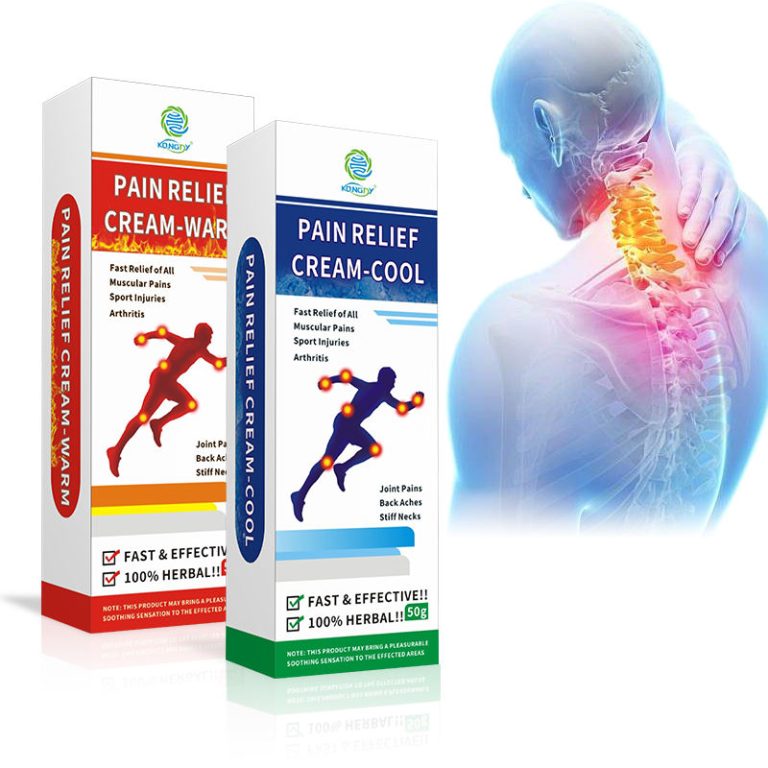
You read the label of a pain cream. You see the active ingredient: menthol 4%, or lidocaine 4%, or capsaicin 0.05%. You think: “That’s what makes it work.”
But the truth is more complex.
A well-formulated pain cream is not just an active ingredient in a random base. It is a carefully engineered system — where active ingredients, excipients, penetration enhancers, and base carriers work together to deliver relief.
As a pain cream OEM manufacturer, Kangzhimei formulates topical products with scientific precision. In this guide, we’ll explain what makes a high-quality pain cream — from ingredient selection to stability engineering.
Part 1: The Dual Architecture of a Pain Cream
Every pain cream has two fundamental components:
The critical insight: A pain cream with the “right” active ingredient but a poorly designed excipient system will fail to deliver relief — because the active never reaches the target tissue.
Long-tail keyword: pain cream formulation science active ingredients
Part 2: Active Ingredients — Choosing the Right One for the Right Pain
The most common active ingredients in OTC pain creams:
Formulation considerations from patent literature:
For 1-menthol (the primary cooling agent in many pain creams), maintaining solubility and preventing crystallization is critical to product performance. The ratio of oil component to menthol mass should be between 0.5 and 19 to prevent menthol recrystallization and ensure consistent skin permeability .
For lidocaine, a typical OTC concentration is 4% — but the delivery system must be designed to prevent precipitation, especially when combined with other actives like NSAIDs .
Long-tail keyword: lidocaine pain cream formulation percentage
Part 3: Inactive Ingredients — The Unsung Heroes of Pain Cream Efficacy
The excipient system is what makes a pain cream absorb, stabilize, and feel good on the skin.
Why base selection matters:
A 2025 patent specification for topical pain formulations highlights that the combination of xylitol and poloxamers (0.5–10% by weight) can significantly improve formulation stability and drug delivery. This combination supports consistent release of actives like lidocaine, diclofenac, and other NSAIDs .
Long-tail keyword: pain cream excipients and penetration enhancers
Part 4: Penetration Enhancement — Getting Past the Skin Barrier
Your skin is designed to keep things out. Getting active ingredients past the stratum corneum requires penetration enhancers.
Common penetration enhancement strategies:
The DMSO caution: DMSO is a powerful penetration enhancer but has regulatory restrictions in some markets. It should be used at appropriate concentrations and with clear labeling.
Kangzhimei’s approach: We use natural penetration enhancers (like eucalyptus oil and lecithin) in our standard formulations, and offer advanced enhancer systems for ODM clients who require maximum delivery efficiency.
Long-tail keyword: pain cream skin penetration enhancer technology
Part 5: The Manufacturing Process — From Formulation to Finished Cream
The production of a high-quality pain cream involves multiple critical steps:
| Step | What Happens | Why It Matters |
|---|---|---|
| 1. Raw material inspection | Active and inactive ingredients are tested for purity and potency | Ensures batch consistency |
| 2. Precision weighing | Ingredients measured to specification | Prevents potency errors |
| 3. Heating and mixing | Oil phase and water phase heated separately, then combined | Emulsion formation — critical for texture and stability |
| 4. Homogenization | High-shear mixing to create uniform particle size | Prevents separation and ensures even active distribution |
| 5. Cooling and deaeration | Mixture cooled and vacuum-deaerated | Removes air bubbles that can degrade product |
| 6. Filling | Automated filling into tubes, jars, or airless pumps | Consistent dosing |
| 7. Quality control | pH, viscosity, active ingredient assay, microbial testing | Ensures product meets specifications |
Rheology control is critical: A topical formulation’s spreadability, drug release, and patient acceptability depend heavily on its rheological properties — the flow behavior that determines how easily it spreads and how well it stays on the application site .
Long-tail keyword: pain cream manufacturing process rheology control
Part 6: Stability — The Difference Between a Reliable Product and a Problem
A pain cream that separates, changes color, or loses potency after six months on the shelf is a brand disaster.
Key stability challenges:
What Kangzhimei does: Every formula undergoes accelerated stability testing (40°C / 75% RH for 3 months) to validate 24-month shelf life. Batch-specific COAs confirm active ingredient potency within ±5% of label claim.
Long-tail keyword: pain cream stability testing shelf life
Part 7: Common Formula Mistakes — What to Avoid
Mistake 1: Using petroleum jelly as the primary base
Petroleum jelly is occlusive — it locks moisture in, but it also locks active ingredients OUT. A high-quality pain cream uses emulsion bases that release active ingredients for absorption.
Mistake 2: No penetration enhancers
Even small molecule actives like menthol benefit from penetration enhancement. Without enhancers, much of the active never reaches the target tissue.
Mistake 3: Inadequate preservative system
Preservatives like methylparaben and propylparaben prevent microbial contamination . A well-preserved pain cream has a documented preservative efficacy test (PET) confirming protection throughout shelf life .
Mistake 4: Ignoring pH
Skin has a natural pH of 4.5–6.5. A pain cream with extreme pH can cause irritation, reducing compliance. pH should be tested and adjusted in every batch.
Long-tail keyword: common pain cream formulation mistakes to avoid
Part 8: The Future of Pain Cream Formulation
Emerging trends in pain cream formulation:
The global market context: The topical drugs contract manufacturing market was valued at $31.14 billion in 2025** and is projected to reach **$85.66 billion by 2034 at an 11.9% CAGR . Pain management is a primary end-use segment, alongside dermatology and wound care.
Long-tail keyword: future trends in topical pain cream formulation
Part 9: Frequently Asked Questions (Formulation Edition)
Q: Why does the same active ingredient work differently in different brands?
A: Formulation matters as much as the active ingredient. Differences in base carrier, penetration enhancers, particle size, and stability engineering explain why some creams provide hours of relief and others only minutes.
Q: What’s the difference between cream, gel, and ointment bases?
A: Creams are oil-water emulsions — balance of absorption and moisturization. Gels are water-based — fast absorption, non-greasy. Ointments are oil-based — occlusive, slow absorption, best for dry skin .
Q: Can multiple active ingredients be combined in one pain cream?
A: Yes — but careful formulation is required to prevent precipitation, stability issues, and skin irritation. Common combinations: lidocaine + menthol; capsaicin + camphor; methyl salicylate + menthol .
Q: How does Kangzhimei ensure batch-to-batch consistency?
A: Every batch undergoes QC testing: active ingredient assay (HPLC), pH, viscosity, microbial testing, and stability monitoring. We provide COAs with every shipment.
Conclusion: Great Formulation Is Not an Accident
The difference between a pain cream that “works okay” and one that delivers consistently reliable relief is formulation science — the careful selection and engineering of active ingredients, excipients, penetration enhancers, and manufacturing processes.
Kangzhimei is a pain cream OEM manufacturer with the formulation expertise to create products that perform.
📧 Contact Kangzhimei today for:
- Free samples of our formulation-optimized pain creams
- OEM/ODM catalog and wholesale pricing
- Custom formulation consultation for your brand
Science is the difference between a cream and a solution.