You’re a brand owner. You see the numbers: the topical pain relief market was valued at $11.3 billion in 2024** and is projected to reach **$20.7 billion by 2035 . The muscle pain relief cream segment alone was valued at $2.825 billion in 2025**, projected to reach **$4.613 billion by 2032 (7.2% CAGR) .
Opportunity is everywhere.
But here’s the challenge: the market is bifurcating. Two distinct competitive arenas are emerging — and each demands a completely different strategy.
As a pain cream OEM manufacturer, Kangzhimei helps brands navigate this complex landscape. In this guide, we’ll analyze the market structure, identify where the growth is, and provide a strategic framework for building a pain cream brand that wins in 2026 and beyond.
Part 1: The Two Arenas — Mass Market vs Premium Benefit-Led
Arena 1: The Mass Market (High Volume, Low Margin)
Arena 2: The Premium / Benefit-Led Segment (Lower Volume, Higher Margin)
The strategic implication: The mass market is a volume game with shrinking margins. The premium segment is a value game where brand differentiation commands pricing power .
Long-tail keyword: premium pain cream market segmentation 2026
Part 2: The Math — Why Premium Segmentation Matters
Mass market economics (private-label pressure):
| Metric | Value |
|---|---|
| Wholesale price (to retailer) | $4–$6 per unit |
| Retailer margin | 40–50% |
| Brand margin (after COGS, marketing, logistics) | 10–15% |
| Competitive response to private label | Price cuts, promotions, shrinking margins |
Premium segment economics (brand differentiation):
| Metric | Value |
|---|---|
| Wholesale price (to retailer) | $12–$25 per unit |
| Retailer margin | 50–60% |
| Brand margin (after COGS, marketing, logistics) | 30–40% |
| Competitive response to private label | Superior claims, clinical data, brand equity |
The critical insight from industry analysis:
“The future profit pool will be concentrated in brands that successfully master a hybrid model: achieving sufficient scale in core mass SKUs to secure shelf presence while concurrently building premium, innovation-led sub-brands with compelling narratives that justify higher price points and resist private-label encroachment.”
Long-tail keyword: pain cream brand profit margins 2026
Part 3: Consumer Segmentation — Target the Right Need States
Demand for pain cream is not monolithic. It is fragmented into distinct need states driven by consumer cohorts, pain etiology, and usage occasions .
Primary need states:
| Need State | Consumer Cohort | Pain Type | Purchase Behavior | Key Formulation |
|---|---|---|---|---|
| Chronic condition management | Seniors (65+), arthritis patients | Osteoarthritis, joint stiffness | High brand loyalty, professional recommendation | Warming (capsaicin, MSM, boswellia) |
| Acute recovery and performance | Athletes, gym-goers (18–45) | DOMS, muscle soreness, sports injuries | Experimental, influencer-driven, community endorsements | Cooling (menthol, arnica, hydrogel) |
| General wellness / temporary relief | Office workers, sedentary lifestyle | Everyday aches, tension, back pain | Price-sensitive, impulse purchase | Dual-action (menthol + camphor) |
| Nerve pain / neuropathy | Diabetic patients, shingles patients | Burning, shooting, electric shocks | Clinical focus, doctor recommendation | Numbing (lidocaine, capsaicin) |
Strategic takeaway: The most commercially successful pain cream brands align a specific benefit platform with a well-defined consumer need state — rather than pursuing generic “relieves pain” positioning .
Long-tail keyword: pain cream target audience segmentation by pain type
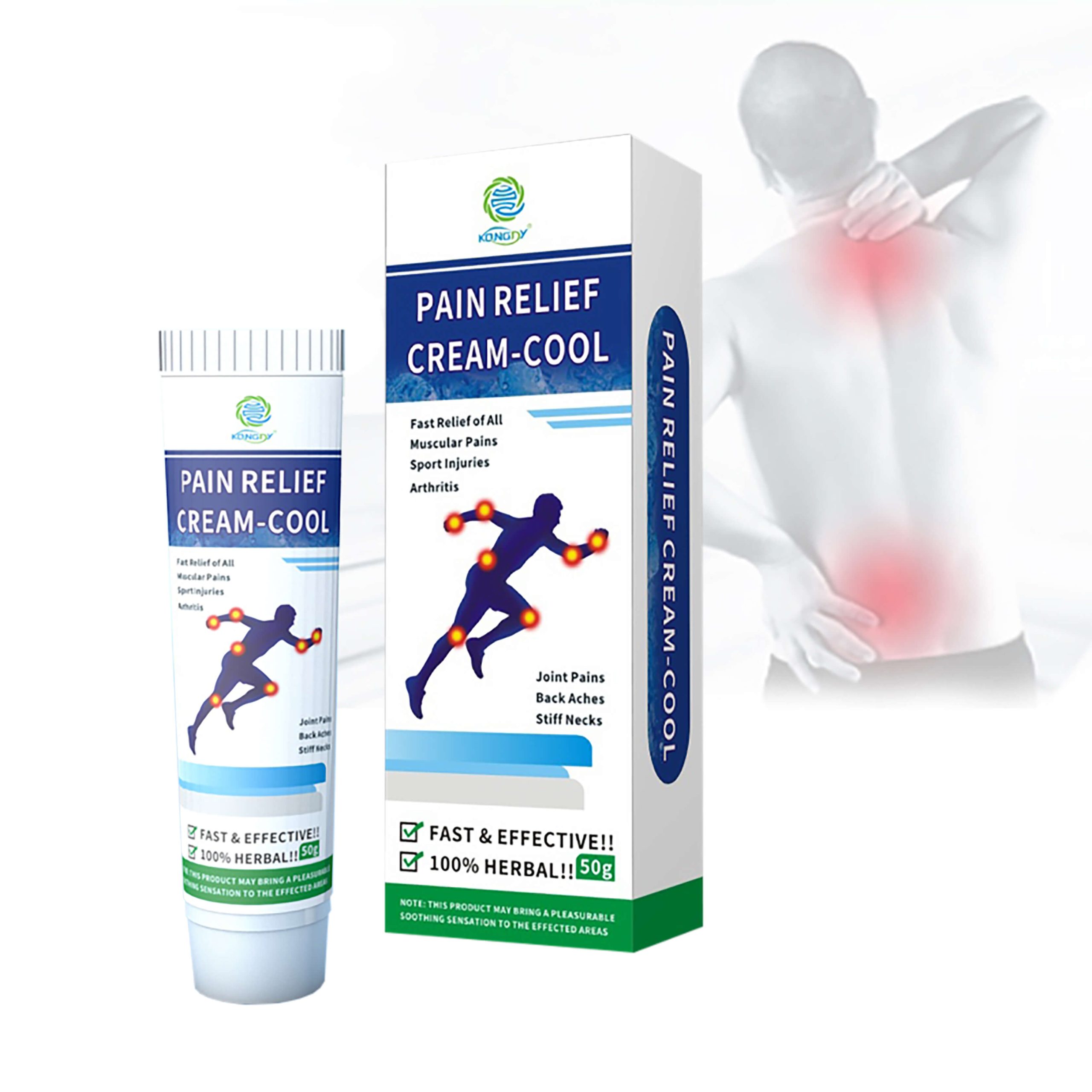
Part 4: The Product Development Framework — Building a Tiered Portfolio
The “price ladder” strategy: Defendable brand architecture requires distinct value propositions at each price tier — each tier with a reason for being that is not easily replicable by private label .
Kangzhimei’s recommended 3-tier pain cream portfolio:
| Tier | Price Point | Consumer | Formulation | Marketing Angle | Kangzhimei OEM Option |
|---|---|---|---|---|---|
| Entry | $8–$12 | Price-sensitive, new category users | Standard menthol/camphor | “Trusted relief at a fair price” | OEM basic cooling cream |
| Core | $15–$22 | Mainstream, repeat purchasers | MSM + menthol + arnica | “Enhanced formula for better results” | OEM advanced recovery cream |
| Premium | $25–$40+ | Brand loyalists, health-conscious | CBD, capsaicin, boswellia, natural claims | “Clinically tested, naturally sourced” | ODM custom premium cream |
Why this works:
| Factor | Explanation |
|---|---|
| Entry tier | Competes with private label — builds trial and shelf presence |
| Core tier | Captures repeat purchases — the profit engine |
| Premium tier | Defends against private label — genuine differentiation, higher margins |
The warning: Over-reliance on deep discounting in the mass segment risks permanent category devaluation, training consumers to buy on promotion only and destroying profitability for all players .
Long-tail keyword: pain cream product line pricing strategy
Part 5: Channel Strategy — Where to Sell
Channel fragmentation is a defining feature of the pain cream market. Economics, packaging, and promotional strategies diverge sharply by channel .
| Channel | Characteristics | Best For | Entry Barriers |
|---|---|---|---|
| Mass grocery / drug | High volume, high slotting fees, promotional intensity | Entry + Core tiers | High (requires trade marketing budget) |
| Specialty wellness | Higher margins, engaged consumers, education-focused | Core + Premium tiers | Medium (need packaging and ingredient integrity) |
| Professional (chiropractic, PT) | Powerful validation, pull-through demand | Premium tier | Medium (need professional sales force) |
| E-commerce / DTC | Direct consumer relationships, subscription models, rich storytelling | All tiers | Low (but requires digital marketing investment) |
The growth frontier: Online distribution is the fastest-growing channel — e-commerce and direct-to-consumer channels are fundamentally reshaping category discovery, claims validation, and subscription-based consumption models .
Long-tail keyword: best sales channels for pain cream brands 2026
Part 6: The Regulatory Landscape — A Key Risk Factor
Regulatory scrutiny on ingredient claims and marketing language is intensifying globally, creating a material risk of portfolio disruption .
Key regulatory considerations:
| Jurisdiction | Key Requirements |
|---|---|
| USA (FDA) | Structure/function claims only for non-drug products; “clinical strength” and “maximum strength” are regulated terms |
| European Union | CPNP notification, REACH compliance, ingredient disclosure; growing scrutiny on “natural” and “clinical” claims |
| Canada (NHP) | Natural Health Product license required for health claims — 6–12 month timeline |
| Australia (TGA) | AUST L listing for listed medicines — 3–6 month timeline |
What this means for brands:
- Investment in compliance and claim substantiation is no longer optional — it’s a competitive necessity
- Regulatory intervention on specific ingredient claims (e.g., CBD, “maximum strength”) could invalidate entire product lines overnight
Kangzhimei’s support: We provide COA, MSDS, stability data, ingredient specifications, and finished product samples for regulatory submission. We do NOT file registrations — that is your or your local agent’s responsibility.
Long-tail keyword: FDA compliance for private label pain cream
Part 7: Kangzhimei’s Role — Your Manufacturing Partner in a Complex Market
What Kangzhimei offers for pain cream brands:
| Capability | Details |
|---|---|
| OEM (white label) | 500 units — test any tier (entry, core, premium) before scaling |
| ODM (custom formula) | 3,000 units — develop proprietary formulations for premium tier |
| Formula library | Cooling, warming, natural, numbing — 50+ proven formulas |
| Natural / clean ingredient focus | Arnica, MSM, boswellia, capsaicin — no parabens, synthetic fragrances |
| Penetration-enhancing base | Natural enhancers (eucalyptus, lecithin) — superior delivery |
| Regulatory documentation | COA, MSDS, stability data — ready for FDA, EU, Canada, Australia |
| Multiple formats | Tubes, jars, airless pumps, roll-ons, sticks — packaging flexibility |
| Mixed SKU orders | Combine entry, core, and premium tiers in one container |
The Kangzhimei advantage for your brand:
| Your Need | Our Solution |
|---|---|
| Test demand before scaling | OEM MOQ of 500 units — low-risk market entry |
| Differentiate from private label | ODM custom formulas — exclusive ingredients, proprietary blends |
| Build a tiered portfolio | Mixed SKU orders — entry, core, premium in one container |
| Meet regulatory requirements | Full documentation package — COA, MSDS, stability |
| Launch quickly | 14–21 day lead time for OEM; 6–8 weeks for ODM |
Part 8: Frequently Asked Questions (Brand Strategy Edition)
Q: Is the pain cream market too crowded for a new brand?
A: The mass market is crowded — but the premium/benefit-led segment is underserved. The market is bifurcating; there is room for brands with genuine differentiation (ingredient storytelling, novel delivery technology, targeted need states) .
Q: Will private-label competition destroy my brand?
A: Not if you differentiate. Private-label is winning in the mass market (copying standard menthol/camphor formulations). But leading retailers are now developing tiered private-label portfolios, including “premium” lines with natural claims. The real threat is to brands without genuine formulation differentiation. Invest in real technology, unique ingredient blends, and compelling narratives .
Q: What are the fastest-growing pain cream segments?
A: Natural/herbal formulations (6–8% CAGR), CBD topicals (13.1% CAGR), and sports recovery creams. These segments are driven by wellness trends, aging demographics, and the shift from oral to topical pain relief .
Q: Should I focus on online or offline sales?
A: Both — but with different strategies. E-commerce/DTC is the growth frontier for premium innovations; mass grocery/drug is the volume engine for entry and core tiers. The most successful brands master a hybrid model .
Q: Can Kangzhimei help me build a premium pain cream brand?
A: Yes. We offer ODM custom formulas (3,000 units) with natural ingredients, penetration-enhancing bases, and premium packaging options. We also provide regulatory documentation for global markets.
Conclusion: The Future Belongs to Brands That Differentiate
The pain cream market is not going away. It’s growing — from $11.3 billion to $20.7 billion by 2035 .
But the rules of the game are changing.
- Mass market: Volume-driven, margin-squeezed, private-label threatened.
- Premium segment: Value-driven, differentiation-rewarded, innovation-led.
The winning brands will master both — a tiered portfolio with entry, core, and premium tiers, each with a defensible reason for being .
Kangzhimei is a pain cream OEM manufacturer that helps brands navigate this complexity. From OEM (500 units) to ODM (3,000 units), from entry-tier to premium, we are your partner in building a brand that wins.
📧 Contact Kangzhimei today for:
- Free samples of our tiered pain cream formulations (entry, core, premium)
- OEM/ODM catalog and wholesale pricing
- Brand strategy consultation — what’s right for your market?
$11.3 billion. Two arenas. One partner. Kangzhimei.